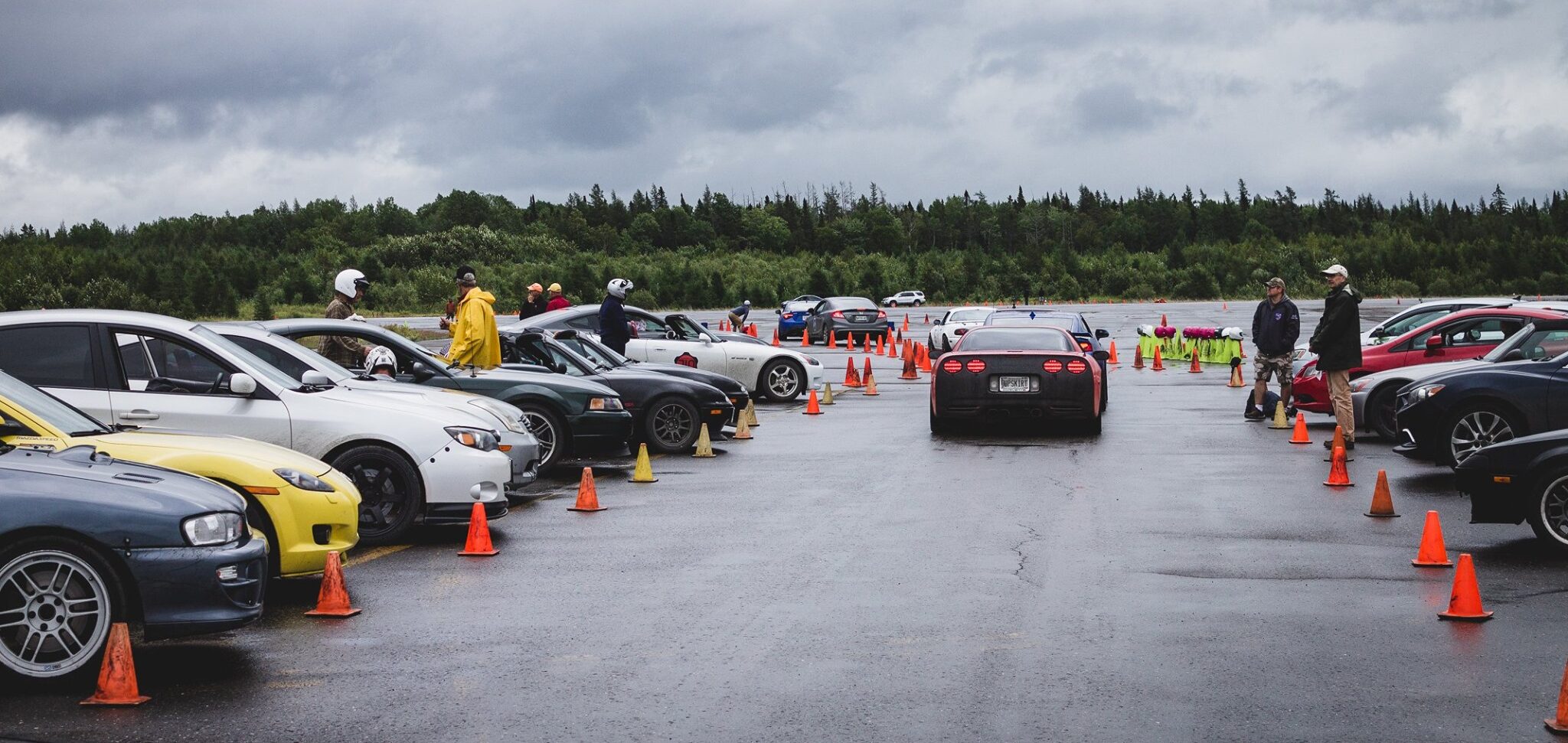
Autocross is a form of motorsports that emphasizes safe, low-cost competition and active participation. An autocross is a timed competition where drivers navigate one at a time through a temporary course marked by traffic cones, rather than racing on a track with multiple other cars, as in road racing or oval racing. Autocross tends to place more emphasis on car handling and driver skill than on sheer horsepower, and events typically have many classes which allow almost any vehicle, from economy sedans to purpose-built vehicles, to compete. Speeds are slower in absolute terms when compared to other forms of motorsports, usually not exceeding highway speeds, but the activity level (measured in discrete turns per minute) can be higher than even Formula One due to the large number of elements packed into each course. Autocross courses are typically 40 to 70 seconds in length. In addition to being a national-level motorsport in its own right, autocrossing is a good way to learn skills that transfer to road racing, as drivers learn vehicle control and club ethics. — Courtesy Wikipedia
Preparation
Make sure your car is in good mechanical working order. It doesn’t have to look pretty or even be street legal, but it does need to be safe. Wheels and suspension should be bolted on tightly. Wheel bearings should have no excessive play. The battery should be clamped or bolted in securely. There should be no excessive fluid leaks. These items will all be checked during a technical inspection the morning of the event, and making sure that any potential issues are addressed beforehand will make it easier for everyone. If you are running on street tires, you will want to inflate them higher than normal to avoid excessive wear during hard cornering. Adding 10psi above the manufacturer specifications is a good general guideline. At the event, feel free to ask other drivers what tire pressures they would recommend for your particular car and tires.
At most events we don’t take a lunch break. There may, or may not, be any nearby restaurants or convenience stores. So bring everything you think you will need for the entire day. Bring more than enough water to get you through the day. Bring more than you think you will need, and drink plenty. It is better for your body, and if you get dehydrated you will not be able to concentrate on your driving as well. Also be sure to bring food and snacks for the day. Sunscreen is important, too. Even if it is cloudy all day, you can still sunburn. If you have rain gear, bring that, too. It doesn’t matter if there is rain in the forecast or not – we live in New England!
You will pick a car number when you register for an event. That number must be displayed on your car while you are running. The most common method for displaying them is with painter’s tape on the side of the car. Regular autocrossers will often use magnetic numbers, but the only requirement is that your numbers are at least 8″ tall and are legible on both sides of the car.
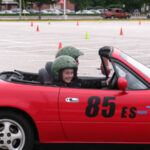 You will also need to choose what class you will be running in. Classes are based on what car you are driving, and what modifications you have made to it. This means that a stock Civic will not compete directly against a turbo Civic, or a Corvette of any kind. CMC borrows its class structure from the SCCA, and adds a few extra classes for karts. More information on car classing can be found here.
Finally, make sure you know where you are going and how to get there. Most of our event sites are easy to find, but after registration closes, no more entries will be accepted. Don’t miss out because you got lost. And, of course, be sure to bring your entry fee.
Registration and Tech Inspection
Pre-registration for all CMC autocross events is done thru MotorsportsReg,com. Pre-registration typically closes a couple days before the event so don’t wait until the last minute to sign up! When you register for your first event you will prompted to select an available car number from a list. That number will then be reserved for you for as long as you are a CMC member.
On the morning of the event, the registration table opens at 7:00am and closes at 7:30am. It doesn’t hurt to arrive a little early to stake out your parking space and unpack your car while you wait. All loose items must be removed from the car – basically anything that isn’t bolted down. When registration opens at the club trailer, get in line to pay your registration fee (if you didn’t pre-pay online), get your work assignment, sign the waiver, and get a wristband. Everyone at the event must sign the waiver and get a wristband, whether they are driving or not.
After you have checked in at registration take your car through tech inspection line. Details will be given at each event as to how tech will be handled. The inspectors will give your car a quick once over. They will want to see inside your trunk to make sure it is empty, and check a few things under the hood. Wherever your battery is located, make sure it is visible so they can confirm that it is secure. If there is a problem, they will tell you what it is and how to fix it. For more info on tech inspections click here.
Course walk
Once you are registered and been thru tech inspection, you may walk the course, which is marked with traffic cones. Especially on your first walk though the course, try to find someone who looks like they know what they’re doing and walk with them to learn where the course goes. It can get confusing at times, but once again competitors are quite willing to help you learn. Once you have finished your first walk, walk it again. Walk the course as many times as you can until you feel reasonably comfortable that you know where you are going.
Driver’s meeting
Everyone must attend the driver’s meeting. The event chair will go over the basic rules, both general and specific to this event. After the main driver’s meeting, experienced drivers are released to get ready, and there is a second, smaller meeting for new people. Here is where you will learn the basics of running, working, cone picking, and so on.
After the driver’s meeting, there is a group course walk for anyone interested. Take this opportunity to learn even more about the course. The walk is often led by the person who designed the course, and he will usually give away some “secrets” about how to follow the course and find your best line through it.
Working
If you are working in the first session, report for work right after the walk-through. (Make sure to bring some water, though, especially on a hot day.) Check in at the trailer, and then assume your position. If you are not working in the first session, report for work immediately after your final run in the session before you work. In a perfect world, all workers would be relieved and replaced before the end of a run group, and the following run group would begin immediately with no interruption. In the real world, there is usually a short pause in the action while the last few workers report to their assignments. The shorter this pause, the more runs everyone will get, so it is crucial that you report to work as quickly as you can. And remember, if you are driving, you MUST work! You may even be disqualified from the event if you don’t!
Running
Unlike many clubs, who create run groups by car class, CMC runs all of the odd numbered cars together, and then all of the even numbered cars together, regardless of class. Each event alternates whether odd or even numbered cars run first. Each group will run twice – once in the morning, and once in the afternoon. And each of these two sessions will usually have from three to six runs at the discretion of the event chair.
When it is your run group’s turn to drive, pull your car into the grid area. If you are sharing your car with another driver look for the “Dual Driver” lane. If you are a single driver get in the “Solo Driver” lane. Grid workers will guide you to the course starting line at the appropriate time. Make sure you are ready to drive when your turn comes. Stay near you car with your helmet and car ready to go. If the grid workers can’t find you when your turn comes up they will skip you and you will lose a run.
If you need to use a loaner helmet, take one as you get close to the start. When you complete your run, leave the finish area and bring the helmet back where you found it as soon as possible – someone else may be waiting for it!
Eventually you will get into line and slowly approach the start. If you would like to find an experienced driver to ride with you, turn on your flashers. We will send someone your way to go for a ride. An experienced driver can talk you through the course and tell you what direction to go. Once you have the course down, they can give you driving advice to help improve your times. You can have someone ride with you on as many or as few runs as you like.
On your first run, don’t worry about your time – just learn the course. It is highly recommended that you ask for an instructor to ride along with you on your first run(s). However many times you walked it, the course looks quite different from inside a car, and it comes toward you a lot faster! Don’t worry if you look like Grandma out for a Sunday drive. Once you successfully navigate the course, you have created a movie in your mind of how it is supposed to look, which makes it easier to drive correctly for the rest of the day. On future runs, go a little faster and see what happens. Eventually, hopefully, you will discover your car’s limits by exceeding them, either by knocking over a cone (which adds a 2 second penalty to your time) or by a dramatic skid. When you make these mistakes, don’t beat yourself up over them – even the best drivers make them sometimes. Instead, think about how you got into the situation, and what you can do differently on your next run to avoid the same problem. It is far better to make these mistakes here, on an autocross course, and hit a cone rather than a tree, car, or pedestrian on the street!
After your final run in the session, park your car. If you are scheduled to work the next shift, report for work as soon as you can. Otherwise, take a break, relax, or try to get some rides with people in the other run group.
End of the day
When everyone is finished running, there’s a lot of cleaning up to do. The course gets taken down and everything gets put back in the trailer. When everyone helps, it doesn’t take long and no one has to work too hard.
By the time cleanup is done, there is a brief awards ceremony. Awards are given for the top driver(s) in each class, as well as a few overall awards. Results are usually posted on the CMC website as soon as possible after the event.